Posted on 1 Comment

Chestnut Pollination Quick Guide

During the 2023-2024 bareroot season, we’re offering six varieties of chestnuts. Chestnut trees usually need a pollinator tree: another chestnut tree with fertile pollen that blooms in the same window. Some chestnut trees are partially, or even fully, self fertile (will produce nuts without a pollinator tree) and some chestnut trees are sterile (meaning they cannot produce their own nuts or be a pollinator tree). Since all this can be confusing, here is a pollination chart for the varieties of chestnuts we offer:

Chestnut Variety*Bloom TimePollinator?
Bouche de BetizacMid-seasonPollen sterile
Belle EpineMid/late-seasonGood pollinator + partially self-fertile
MaravalEarlyGood pollinator + self-fertile
Marron di val di susaLate-seasonPollen sterile
TsukubaMid-seasonunknown?
ColossalEarlyPollen sterile
Some good combinations are:
Bouche de Betizac and Belle Epine,
Maraval and Colossal,
or Marron di val di susa with Belle Epine.

More information is needed for Tsukuba.

*Please note that all our chestnut trees are seedlings and will show some genetic variability from their parent tree. All our chestnut seedlings are grown from nuts/seeds that were originally pollinated by a pollinator tree, which will hopefully improve pollination characteristics of the seedling.
Posted on 1 Comment

The Misunderstood Walnut

Sam here. I recently found out that walnuts are considered an invasive species. We had a member of the local watershed council out to walk the section of Price Creek that runs through our piece of land. He points to a beautiful tree in the riparian understory and recommends we cut it down. There was only one walnut tree, competing for light with mature Oregon white oaks and big leaf maples. I had not yet known this tree was there (yet to identify it as a walnut anyways) and was ecstatic at the thought of collecting buckets of rich buttery nuts and bringing them home for my family. Needless to say, I told the watershed council member that we were keeping the tree – and had to break it to him that we were propagating walnuts to plant throughout our land and sell.

Back downstream at the nursery, it has been a long hot summer for our young nut trees. The walnuts have fared as well as any of the nut trees (shoutout to the northern pecans for also beating the heat). We lost some chestnut seedlings due to the lack of water and too much sun. Some hazelnuts shed their leaves in the heat only to recently send out a new round of young buds. We’ve learned some important lessons this year.

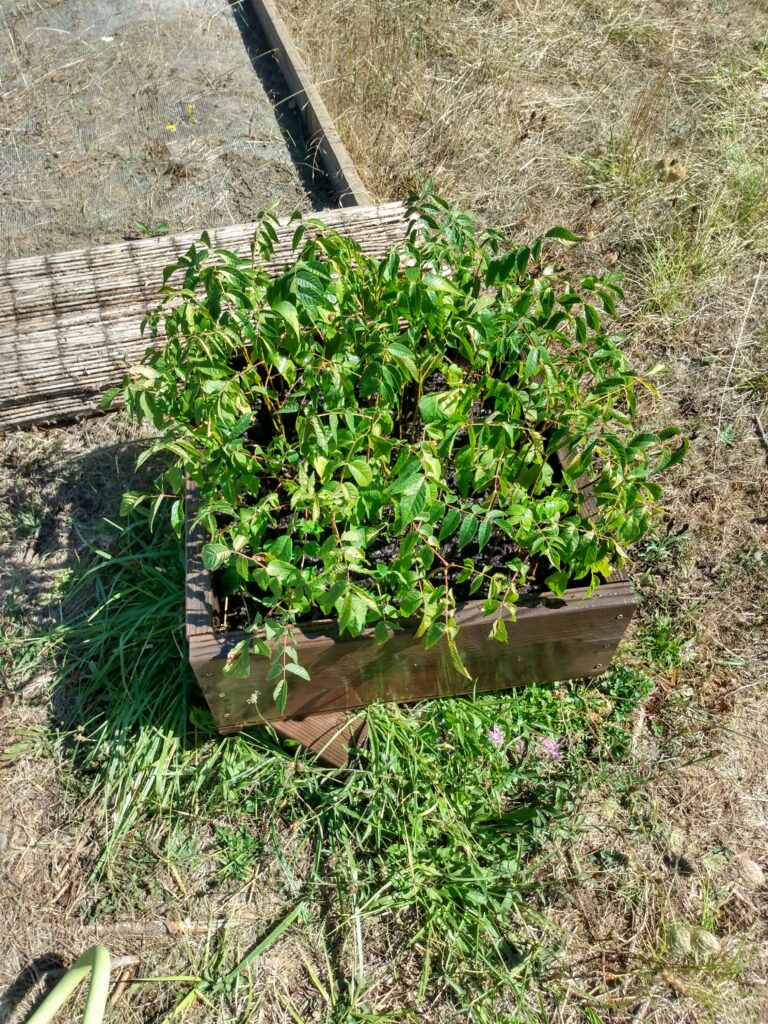
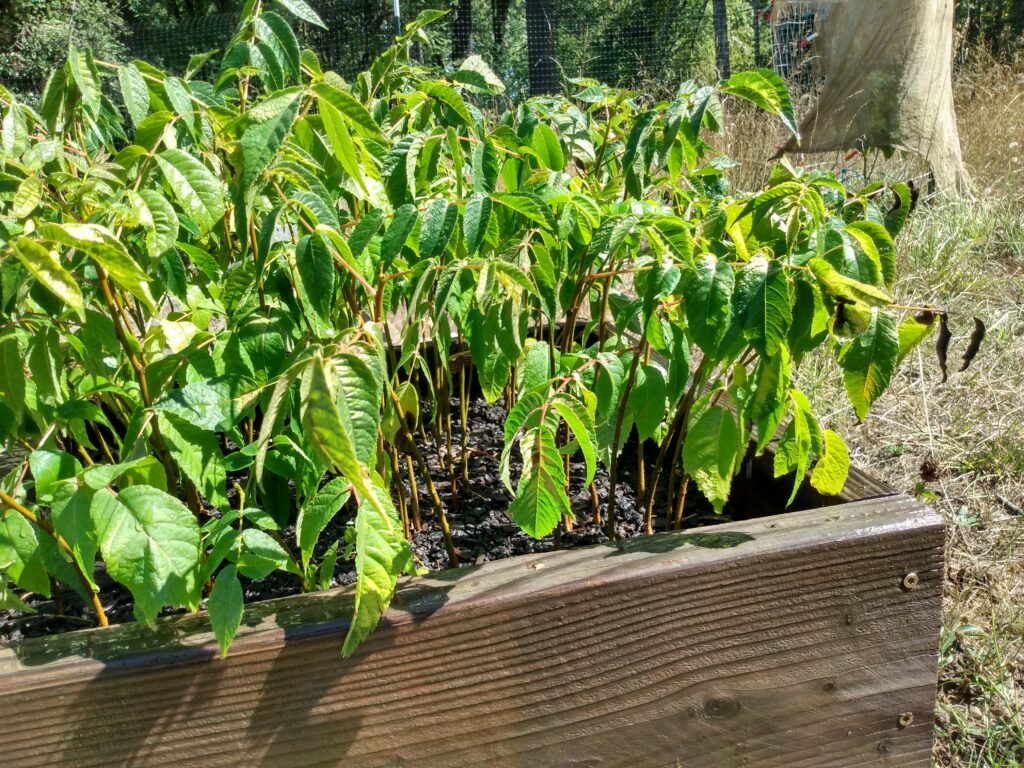
hinds black walnut, looking hot but still healthy

Through drought and heat, however, the walnut family is going strong. Our hinds black walnut trees (pictures above) have all survived with no shade all season. They are also in our smallest air prune bed (dries out faster than any other). I’ve heard black walnut trees can thrive in wet areas, and it seems they can tolerate drought too. Our beds with English walnuts are somewhat sparse (due to less than ideal germination), but the trees have all survived (picture below). The butternut, or white walnut, trees have also all survived.

healthy English walnuts after the summer heat

The walnut is a hardy tree that grows one of the healthiest plant-based foods we know of. Walnuts are extremely high in omega-3’s and the tree has even been called “the butter tree.” The nuts can also be stored for the entire winter. Imagine a world where ample walnuts are available to feed the masses. I know I’ll keep planting walnut trees, and ask you all to join me. All trees I mentioned ( the hinds black walnut, English walnut, and butternut) will be available bareroot this winter; on our site or at the Corvallis indoor winter market.